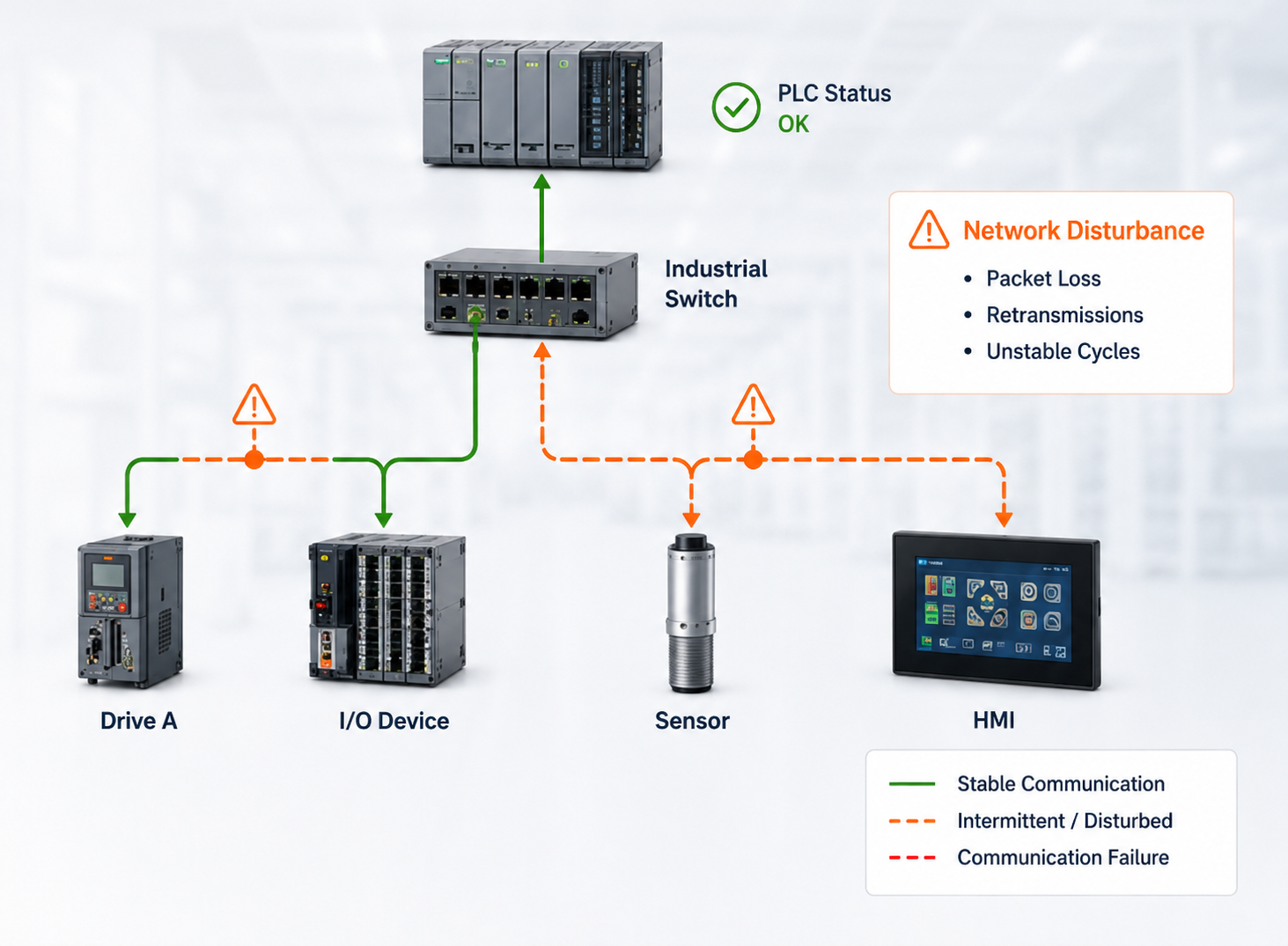
Before blaming the PLC, check the network

Many industrial network problems start long before the PLC alarm appears.

Unstable communication, packet loss, EMC interference or excessive network traffic can silently affect Industrial Ethernet performance without triggering clear alarms

The Result?

random communication faults

unstable machine behavior

delayed I/O responses

temporary device dropouts

inconsistent cycle times

troubleshooting that takes far too long

In many cases, the PLC is only reacting to a disturbance happening somewhere else in the network.

Why the PLC gets blamed

Most automation tools show symptoms — not root causes.

A PLC may report a device timeout.
An HMI may display a communication fault.
But neither explains what caused the disturbance in the first place.

Because the alarm appears inside the controller, engineers often begin troubleshooting the PLC while the actual issue remains hidden deeper inside the network infrastructure.

Hidden causes inside industrial networks

Industrial Ethernet networks depend on stable, predictable communication between controllers, drives, IO devices and sensors.

Common causes of communication instability include

packet loss and retransmissions

excessive network load

unstable communication timing

cable or shielding issues

improper grounding

EMC interference from drives and power electronics

These problems often appear intermittently, making them difficult to identify using standard PLC diagnostics alone.

Many communication disturbances occur below the application layer and remain invisible in standard PLC diagnostics.

Many communication problems originate below the controller level, inside the communication infrastructure or physical network layer, where traditional diagnostics provide limited visibility.

As a result, engineers often see the symptoms of a disturbance without seeing the actual network conditions causing it.

This is why communication problems can remain unresolved for long periods of time, especially when faults occur sporadically or inconsistently.


Why disturbances are difficult to diagnose

A common source of hidden disturbances

Electromagnetic interference (EMC) is one of the most overlooked causes of unstable industrial communication.

Drives, motors, power electronics and improper grounding can introduce electrical noise into the network environment, affecting communication quality without creating obvious alarms.

Because these disturbances often appear intermittently, identifying EMC as the root cause can be especially difficult without proper network visibility.

Why network visibility matters

You can’t troubleshoot what you can’t see.

Industrial network diagnostics help engineers identify:

Packet loss
Missing data packets that disrupt reliable communication between devices and control systems.

Retransmissions
Repeated data transfers caused by communication errors or unstable network conditions.

Communication instability
Intermittent network behavior leading to unpredictable machine or system communication.

Network load conditions
High traffic levels that can impact response times and reduce overall network performance.

EMC-related disturbances
Electromagnetic interference affecting signal quality and causing communication disruptions.

Physical layer problems
Cable, connector or shielding issues that reduce network reliability and stability.

Better visibility means faster troubleshooting, reduced downtime and more stable production systems.

Technical Webinar:

Troubleshooting for Industrial Fieldbus Networks

Learn how to identify, analyze and resolve communication issues in industrial fieldbus and Ethernet networks.

This technical webinar covers practical troubleshooting strategies for:

random communication faults

unstable machine behavior

delayed I/O responses

temporary device dropouts

inconsistent cycle times

troubleshooting that takes far too long

Topics include:

sporadic communication failures

unstable network behavior

EMC-related disturbances

structured diagnostics methods

common failure patterns in industrial automation networks

strategies to reduce downtime and improve network reliability

The session focuses on practical troubleshooting approaches engineers can apply directly in real industrial environments.

In dialogue with you

„Most network problems don’t start where the alarm appears“

Brian Nolen

Indu Sol America, LLC

980 Birmingham Rd. Ste 721
Alpharetta, GA 30004

Phone: +1 629 333 0057
Email: brian.nolen@indu-sol.com
Web: https://indusolamerica.com

Discuss your network challenges directly with an expert.